
Quick answer: what do people talk about?
Mostly other people. Ask Americans what they talk about with family and close friends, and the top answer by far is what's happening with family and friends: 69% say they talk about it "a lot", in a 2024 Pew Research Center survey of 8,709 adults. Next come jobs, work or school (46%) and whatever people are watching or listening to (38%). Politics (18%) and celebrities (6%) sit near the bottom.
Studies that record real conversations point the same way. The psychologist Robin Dunbar, summing up his group's observations of relaxed conversations, put it at about two thirds of conversation time going to social topics: the speakers and the people they know.
So normal people are not talking about anything special. They trade small, specific news about their lives and the people in them. Pick a topic someone can answer without performing, add one detail of your own, and you are doing what everyone else is doing. The 50 topics below each come with a line to say and a follow-up.
Key findings
- 69% of US adults say they talk "a lot" about what's happening with family and friends when they get together with family or close friends, the top of 12 topics in a Pew survey of 8,709 adults (April 2024). Political issues: 18%. Celebrities: 6%.
- Only 4% of Americans recalled talking about the weather in the past week, in an open-ended Gallup poll of 1,018 adults (June 2019). Family or personal matters: 46%. Their job: 17%.
- About 14% of everyday conversations are gossip, and most of it is harmless. In recordings of 467 people, almost three quarters of gossip was neutral, and acquaintances came up about nine times as often as celebrities (3,292 samples vs 369; Robbins and Karan, 2019).
- Small talk is a minority of what recorders hear. Among 79 students who wore a recorder for four days, 17.9% of conversations were small talk and 35.5% were substantive (Mehl and colleagues, 2010).
- Strangers talk about the news, and about family. In 1,656 recorded conversations between strangers in 2020, topics rose and fell with COVID-19 and the election, and family and children came up almost everywhere (Reece and colleagues, 2023).
What this can and can't tell you
- Most of the data is American. Pew and Gallup surveyed US adults; the recording studies mostly used US students or volunteers. Other countries may rank topics differently.
- Surveys measure what people remember and report. Pew asked how much people talk about each of 12 topics it chose; Gallup asked what people recall from the past week. Neither recorded anything.
- Recording studies are small and specific. The recorder studies sample short snippets from a few days in a few hundred lives. The numbers come from different categories, so they don't add up to 100% and can't be stacked into one pie.
- What we read: abstracts for most studies, full texts for Mehl 2010 and the CANDOR paper, the Pew topline and the Gallup and UC Riverside pages. We did not read Dunbar's 1997 paper in full (it is paywalled), so the "two thirds" figure is quoted from his 2004 review. Details are in the method box.
What people say they talk about
Two big surveys asked Americans directly.
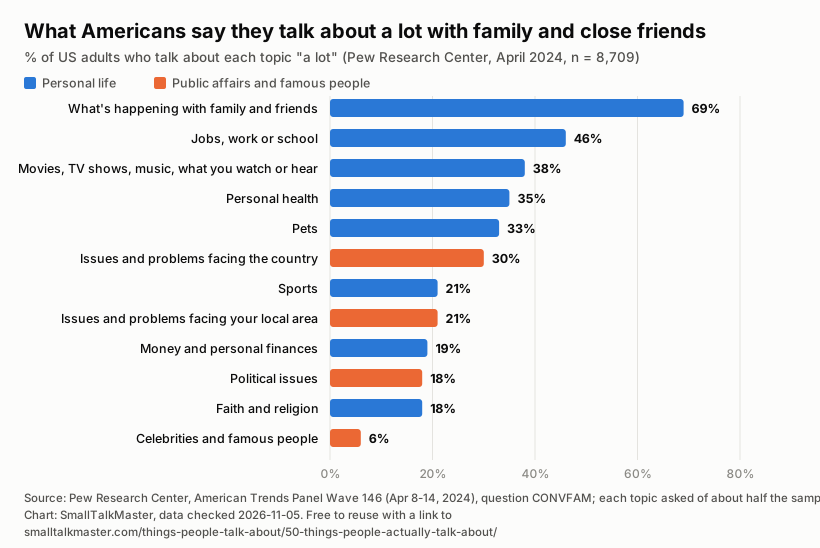
Pew, 2024. Pew asked 8,709 adults on its American Trends Panel how much they talk about 12 topics "when you get together with family or close friends". Each topic was asked of about half the sample. Family and friends' news won easily (69% "a lot"), and almost nobody (3%) said "not at all". Adults under 50 talk about work or school a lot far more often than those 50 and older (58% vs 32%), and about what they're watching too (44% vs 30%). A third of people talk about their pets a lot, 39% of women and 27% of men. The full numbers are in Pew's topline.
Gallup, 2019. Gallup phoned 1,018 adults and asked an open question: "Thinking about the conversations you had in the past week with friends or family, what are the major things you recall talking about?" People named:
| What they recalled | Share |
|---|---|
| Family or personal matters (family, health, school, pets) | 46% |
| Politics | 24% |
| Recreation (travel, sports, food, movies, music, books) | 22% |
| Their job or work | 17% |
| Personal finances and income | 7% |
| Current events | 5% |
| The weather | 4% |
| Religion or church work | 4% |
Overall, 77% mentioned personal affairs and 34% public affairs. Gallup had asked a version of the question in 1966, when the top topic was the Vietnam War (21%), but that version told people to leave personal matters out, so the two years can't be compared directly.
Notice the weather. It's the cliché of small talk, yet only 4% remembered talking about it. Weather is a door, not a room: it opens a conversation and then gets out of the way.
What recorders actually hear
People can misremember what they talk about. So a few research teams listened instead.
Field notes (1922 onwards). In 1922 the psychologist Henry Moore ran a field observation study of conversation topics, the first systematic study of how men's and women's topics differ, according to Katherine Bischoping's 1993 paper. Bischoping reports a 1990 replication that found "similar but smaller" gender differences, and argues that setting, audience, who was studied and the researchers' own intentions may account for part of the change across seven decades of studies.
Dunbar's observations (1997). Robin Dunbar, Anna Marriott and Neill Duncan observed conversations in relaxed social settings. Their abstract reports that talk "consist[s] predominantly of exchanges of social information", mostly about the speaker or other people, and that very little of it was criticism or advice. Dunbar's 2004 review gives the figure people now quote: approximately two thirds of conversation time on social topics, "most of which can be given the generic label gossip". In this sense gossip just means talking about people.
Recorders clipped to real lives (2010, 2019). The Electronically Activated Recorder (EAR) records short snippets of sound through the day, and coders sort what they hear.
- In Mehl, Vazire, Holleran and Clark's study of 79 students over four days, 17.9% of conversations were coded as small talk ("only trivial information is exchanged") and 35.5% as substantive. The happiest students had less small talk and more substantive conversations than the unhappiest. A pooled follow-up with 486 people (Milek and colleagues, 2018) found "no reliable association with small talk", so don't read it as "small talk makes you unhappy". Our small talk statistics check has the full story.
- Megan Robbins and Alexander Karan pooled five EAR studies with 467 people aged 18 to 58 and coded gossip as any talk about someone not present. About 14% of conversations were gossip, which the UC Riverside summary puts at about 52 minutes a day. Almost three quarters of it was neutral, negative gossip (604 instances) outnumbered positive (376), and it was overwhelmingly about acquaintances (3,292 samples) rather than celebrities (369). Extraverts gossiped more than introverts.
Strangers on video (2020). The CANDOR corpus recorded 1,656 conversations between strangers across the US, each at least 25 minutes long (31.3 on average). People were told to "imagine you have met someone at a social event and you're getting to know each other". A simple keyword count showed the news shaping the talk: COVID-19, the election and police killings rose and fell through the year. The authors also note "the near-universal inclination of people everywhere to want to talk about their family and children". And they point out what strangers lack: gossip about mutual acquaintances, the talk that dominates everyday conversation between people who know each other.
Said vs. heard: the evidence side by side
| Question | What people say (surveys) | What recorders hear (studies) |
|---|---|---|
| What comes up most? | Family and friends' news: 69% talk about it a lot (Pew); family or personal matters 46% in the past week (Gallup) | Social topics, about two thirds of conversation time (Dunbar) |
| How much is about other people? | Celebrities: 6% talk about them a lot (Pew) | Gossip about 14% of conversations, mostly neutral, mostly about acquaintances (Robbins and Karan) |
| How much is small talk? | Not asked | 17.9% of students' conversations (Mehl and colleagues) |
| Politics? | 18% a lot (Pew); 24% in the past week (Gallup) | Strangers' talk about the election rose with the news in 2020 (CANDOR) |
| Weather? | 4% recalled it (Gallup) | Not measured separately |
| Strangers vs people you know | Surveys asked about family and close friends | Strangers talk about the news and family; acquaintance gossip needs people in common (CANDOR) |
The two kinds of evidence agree on the big picture: people talk mostly about their own lives and the people in them. They differ on details because they measure different things.
What this means for your next conversation
With people you know, ask about the people and projects in their life. "How did your sister's move go?" beats any clever topic, because news about family and friends is what most people want to share.
With strangers, you have no people in common yet. Start with the shared situation, then their week, work or what they're watching, and let family come up when they mention it. The CANDOR strangers got there on their own.
Don't fear "boring" topics. Work, pets and what you're watching are top topics because they're easy to answer. The detail you add is what makes them interesting.
The six topics that carry most conversations
| Topic | Why it works | Line to try | Follow-up |
|---|---|---|---|
| The shared situation | Nobody has to invent context | "Is it always this packed in here?" | "What brings you here tonight?" |
| The day or week | Everyone has one | "Has your week been calm or chaotic?" | "What made it that way?" |
| Work or school | Second only to family and friends in Pew's survey | "What's eating most of your time at work lately?" | "Is that the fun part or the annoying part?" |
| The people in their life | The top topic in every survey above | "Did your brother end up taking that job?" | "How's he finding it?" |
| What they're watching, eating, playing | Easy opinions, low stakes | "Watched anything good lately?" | "Would you tell me to start it?" |
| Plans and places | Gives the talk somewhere to go | "Anything coming up you're looking forward to?" | "Have you done that before?" |
If your mind goes blank, start at the top of that table. The situation you are in is always available. "The people in their life" works once you know a little about them; with a stranger, wait until they mention someone.
Why normal conversation sounds so ordinary (and still works)
If you have ever listened to two people chat and thought, "What do people even talk about? That was nothing," you were half right. Most casual talk is low-content on purpose. Its job is to show you are friendly, find out what the other person cares about, and leave room for something better to come up.
That is why reachable beats impressive. "What do you think about the future of society?" asks for a speech. "Has this week felt weirdly long to you?" asks for a small reaction, which is much easier to give a near-stranger.
Good casual topics share three qualities: they connect to the moment, they are easy to answer, and they leave room for a tiny personal detail. The detail is what turns small talk into a real conversation. "I like movies" is flat. "I watched a movie last night that was almost good, which annoyed me more than if it had been bad" gives the other person something to grab.
What people who ask "what do I talk about?" are really stuck on
We re-read 14 questions on Interpersonal Skills Stack Exchange where the asker didn't know what to talk about, found in our census of 3,958 questions. Fourteen is a reading, not a count, but the pattern was clear: none of them asked for a general list of topics. Eleven had one specific person or group in mind.
- A coworker: walking home with a colleague who shares none of your interests (6523), a lunch table where nobody speaks (5443), building rapport at work with someone you find dull (18575).
- A friend or a friend of a friend: a mutual friend's friend on the bus every morning (99), university friends at dinner (16842), old friends after years of silence (7310), an online friend where every chat is about the same game (9841).
- Someone you like: a crush who is easy to talk to in a group but not alone (20292), texting someone after a first chat about a single topic (13012), dating chats that stall at "I like food and sleep" (25701).
- A mixed group: a birthday party where friends from different parts of life might run out of common ground (22387).
- The rest were about the topics themselves: wanting small talk that gets at what drives people (4005), how to describe a quiet few months without showing off (26725), and parties where every topic is a luxury holiday (15950).
Questions paraphrased; Stack Exchange content is licensed CC BY-SA. If you're stuck with one person, the situation table below is a better start than the full list.
50 things people actually talk about
Each entry has a line you could actually say and a follow-up for when they answer. They run roughly from easiest to more personal: 1 to 10 are the moment and your week, 11 to 20 food, screens and small wins, 21 to 30 people, places and routines, 31 to 40 learning, stuff and surroundings, and 41 to 50 opinions, memories and wrapping up.
1. The thing happening right now
"This room has that first-ten-minutes-of-an-event energy."
Follow-up: "Do you usually come to these, or is this a first?"
Shared situations are the easiest start because nobody has to invent context.
2. How they know the host or group
"I'm still piecing together how everyone knows each other. What's your connection?"
Follow-up: "How long have you two known each other?"
Works at parties, weddings, meetups, and group dinners.
3. The day they have had
"Has today been calm for you or one of those weirdly busy days?"
Follow-up: "What made it busy?"
Better than "How are you?" because it offers two easy choices. More swaps like this are in what to say instead of "How are you?".
4. The week so far
"Is your week behaving itself?"
Follow-up: "What's the one thing you're trying to get through before Friday?"
Light, flexible, and easy to answer honestly.
5. Weekend plans
"Do you have a real weekend coming up or a recovery weekend?"
Follow-up: "What would the perfect version of it look like?"
Invites something more specific than "Anything fun?"
6. What they are looking forward to
"Anything coming up that you're actually excited about?"
Follow-up: "How long have you been waiting for that?"
The word "actually" keeps it from sounding formal.
7. Work, but the human version
"What part of your work takes the most energy lately?"
Follow-up: "Is that the part you like or the part you'd hand off?"
Far better than asking for a job title and then freezing.
8. School or classes
"Which class is taking up the most space in your brain right now?"
Follow-up: "Is it hard, or just a lot?"
Students almost always have a real answer.
9. Commutes and getting around
"Did getting here behave, or was it a whole side quest?"
Follow-up: "Is that your usual route?"
People often have a small travel story ready.
10. Local places
"Have you found any places around here that are actually worth going back to?"
Follow-up: "What do you order there?"
Works in cities, on campus, in neighborhoods, and near offices.
11. Food opinions
"What's a food you think is overhyped?"
Follow-up: "Okay, what's underrated then?"
Everyone has a food opinion, and none of them are dangerous.
12. Recent meals
"What's the best thing you've eaten recently?"
Follow-up: "Where was that?"
Sounds small, but it opens into restaurants, family, cooking, and travel.
13. Cooking attempts
"Are you a follow-the-recipe person or an improvise-and-hope person?"
Follow-up: "What's your most reliable dish?"
Lets people laugh at themselves a little.
14. Shows
"Have you watched anything lately that was worth the time?"
Follow-up: "Would you tell me to start it?"
Don't demand a favorite. Ask for recent.
15. Movies
"What's a movie you expected nothing from but ended up liking?"
Follow-up: "What won you over?"
Much easier than "What's your favorite movie ever?"
16. Music
"What have you been playing too much lately?"
Follow-up: "Is that new for you or an old favorite coming back?"
People know what they repeat.
17. Podcasts or videos
"Have you fallen into any weird corner of the internet lately?"
Follow-up: "How did you end up there?"
Leads to hobbies, history, science, comedy, or niche drama.
18. Sports in light doses
"Are you actually following the season, or just hearing about it from everyone else?"
Follow-up: "Who are you stuck rooting for?"
Lets fans and non-fans both answer.
19. A small win
"What's gone right for you this week, even if it's tiny?"
Follow-up: "Did you celebrate, or just quietly enjoy it?"
Use with people who already seem warm. It can feel too earnest as a cold opener.
20. A small complaint
"What's been the most ridiculous part of your day?"
Follow-up: "Is that a regular problem or a one-off?"
Shared complaining bonds people. Keep it playful and short.
21. Pets
"Do you have any animals at home, or do you just borrow other people's animal stories?"
Follow-up: "What's their most ridiculous habit?"
A third of Americans say they talk about pets a lot. People without pets can still answer this one.
22. Family in light doses
"Are you from around here originally, or did you end up here another way?"
Follow-up: "Is your family still back there?"
Safer than asking directly about parents, partners, or kids. Once they mention someone, ask about that person next time: it's the topic people talk about most.
23. Where they are from
"What's something people misunderstand about where you grew up?"
Follow-up: "Would you ever move back?"
Gets better answers than "Where are you from?"
24. Places they have lived
"Have you always been in this area?"
Follow-up: "Which place felt most like home?"
Simple, and it opens a lot of doors.
25. Travel that actually happened
"What's a trip you still think about sometimes?"
Follow-up: "What made that one stick?"
Let it be local, family, or funny. Don't turn travel into a status contest.
26. Trips they want to take
"Is there a place you keep saying you'll visit eventually?"
Follow-up: "What's stopping you?"
Light dreaming without getting heavy.
27. Daily routines
"Are you a planned-day person or a figure-it-out-as-you-go person?"
Follow-up: "Has that always been true?"
People show a lot of personality through routines.
28. Sleep
"Did you sleep like a responsible adult last night or like someone fighting the clock?"
Follow-up: "Morning person or night person?"
Almost everyone has feelings about sleep.
29. Exercise without pressure
"Have you found any way of moving around that you don't hate?"
Follow-up: "How did you find it?"
Avoids sounding like a fitness interview.
30. Hobbies
"What do you do when your brain needs a different channel?"
Follow-up: "How did you get into that?"
Gentler than "What are your hobbies?"
31. Things they used to be into
"What's something you were obsessed with for one phase of your life?"
Follow-up: "Any of it left in your life now?"
Often gets the funniest answers of the night.
32. Things they are learning
"Are you trying to get better at anything lately?"
Follow-up: "What's the hardest part so far?"
Keep your tone light so it doesn't sound like a performance review.
33. Skills they wish they had
"What's one skill you wish you could download instantly?"
Follow-up: "What would you do with it first?"
Playful and easy for anyone.
34. Small purchases
"Have you bought anything recently that made daily life slightly better?"
Follow-up: "Would you buy it again?"
People love talking about useful little fixes.
35. Annoying technology
"What app or device has been testing your patience lately?"
Follow-up: "Have you found a workaround, or are you just suffering?"
A quick shared reality. Don't let it become a long rant.
36. Weather when it affects life
"This weather is messing with my plans. Did it change anything for you?"
Follow-up: "What would you be doing if it were nice out?"
Weather only works when it has consequences. In Gallup's poll just 4% even remembered talking about it, so use it to open, then move on.
37. The neighborhood
"Have you noticed how this area changes completely depending on the time of day?"
Follow-up: "When do you like it best?"
Specific local observations feel more alive than generic questions.
38. Events nearby
"Have you been to one of these before, or is this also an experiment for you?"
Follow-up: "What made you pick this one?"
Great for meetups, panels, shows, and campus events.
39. How crowded or quiet a place is
"I can't tell if this is a normal crowd or if everyone had the same idea at once."
Follow-up: "Do you come here often enough to know?"
Shared logistics are underrated.
40. The best part of the room
"I respect whoever chose this playlist."
Follow-up: if they agree, "What would you put on next?"
Not every observation has to be a question.
41. Light opinions
"What's something small you're weirdly particular about?"
Follow-up: "Has anyone ever fought you on it?"
Invites personality without going too private.
42. Mild preferences
"Window seat or aisle seat?"
Follow-up: "Is there a story behind that?"
Tiny choices often open bigger stories.
43. Childhood trends
"What was the thing everyone at your school cared about for no good reason?"
Follow-up: "Were you into it or above it?"
Best with people around your age or when nostalgia is already in the air.
44. Funny mistakes
"What's a tiny mistake you made recently that your brain keeps replaying?"
Follow-up: "Did anyone else even notice?"
Share yours first if the other person seems shy.
45. Good advice
"What's a small piece of advice that actually helped you?"
Follow-up: "Who gave it to you?"
This can get meaningful fast, so don't use it in the first minute.
46. Bad advice
"What advice sounds wise but is mostly useless?"
Follow-up: "Did you follow it for a while?"
Gets real opinions without getting serious.
47. Random facts
"I read that when Gallup asked Americans what they'd talked about that week, only 4% said the weather. So I've stopped opening with it. What do you actually end up talking about with people?"
Follow-up: "Is that the same at work and at home?"
Random facts work when you attach a human reaction and hand the question back. The fact here comes from the Gallup poll above; check any fact before you repeat it.
48. Things they recently noticed
"Have you noticed anything around here that everyone else seems to ignore?"
Follow-up: "How long did it take you to spot that?"
Good with observant people.
49. What surprised them
"What surprised you about this place when you first came here?"
Follow-up: "Has it grown on you?"
Useful for workplaces, schools, new cities, and groups.
50. The next small move
"Are you staying for the whole thing or doing the strategic early exit?"
Follow-up: "What's next on your night?"
Leads to plans and honest talk, and gives you both an easy exit later.
What to talk about by situation
You don't need all fifty. Pick two or three that fit the room you're walking into.
| Situation | Topics from the list | Opening line |
|---|---|---|
| Party where you know one person | 2, 38, 50 | "How do you know the host?" |
| Work, near the kitchen or before a meeting | 4, 7, 9, 35 | "Is your week behaving itself?" |
| A coworker you see every day | 7, 14, 22 | "Did your weekend plans with your sister work out?" |
| First date | 12, 15, 26, 31 | "What's the best thing you've eaten recently?" |
| Dinner with new people | 11, 23, 25 | "What's a food you think is overhyped?" |
| Class, club, or campus event | 8, 10, 49 | "Which class is taking over your brain right now?" |
| Waiting in line or on a delay | 36, 39, 40 | "I can't tell if this is normal or if everyone had the same idea." |
| Neighbors | 10, 21, 37 | "Have you found anywhere around here worth going back to?" |
| Family gathering or older relatives | 24, 43, 45 | "What's the best advice anyone ever gave you?" |
| Old friend after a long gap | 22, 31, 50 | "I was thinking about that summer we… How's your family these days?" |
For deeper scripts, see what to say at a party where you know one person, how to make small talk at work, what to talk about on a first date, what to talk about at dinner with new people and how to introduce yourself.
How to turn a topic into an actual exchange
A topic alone won't carry a conversation. Use a three-part rhythm:
- Notice something.
- Ask an easy question.
- Share a small detail back.
Example:
"This event has more people than I expected. Have you been to one of these before?"
They say, "No, first time."
You say, "Same. I'm in the phase where I pretend to understand the room before I actually do."
Now they can laugh, relate, or tell you why they came. Your tiny honest detail did as much work as the topic. As a rough guide, aim to talk about half the time. If you tend to hold back, the research behind the 43:57 rule suggests you can share more than you think.
Mistakes to avoid
Treating topics like a checklist
If someone lights up on one topic, stay there. Jumping from work to movies to travel feels like filling out a form.
Asking the biggest version of the question
"What's your passion?" feels intense. "What's been taking up your free time lately?" is easier to answer.
Making every topic about achievement
Conversations that sound like resumes get tiring. Ask about enjoyment, weirdness, effort, and everyday life too.
Bringing up heavy topics too early
Politics, money, religion, health problems, and relationship drama can be real conversation, but they need trust and timing. Pew's numbers fit this: even with family and close friends, fewer than one in five people talk about politics, religion or money a lot. If you want a starting set that stays light without going empty, see safe topics for small talk.
Turning "talking about people" into trashing people
Most everyday gossip is neutral news about who's doing what. Keep it that way: "Did Sam get the flat?" is connection; "Can you believe Sam…" is a different conversation.
Refusing to share anything
If you only ask, the other person carries all the vulnerability. Give a little back.
A soft way to have more to say
Sometimes the problem isn't a shortage of lines. Your week has been work, scrolling, errands, and sleep, so your brain can't find a fresh thread.
That's normal. One easy fix is to learn one small thing before you go somewhere: a strange bit of history, a psychology idea, a science fact, a local story, or a practical skill. It gives you a real hook that belongs to you.
NerdSip can help with that. It turns almost any topic into short lessons, quizzes, and takeaways, on iOS and Android. NerdSip is a learning app made by ai51, the company that publishes this site. Use it like curiosity fuel, not homework. The goal is to walk in with one fresh idea you actually care about.
The simple rule
Before you bring up a topic, ask yourself: "Can this person answer without performing?"
If yes, try it. Then listen for the first detail that has some life in it, usually a person or a plan, and follow that instead of your list.
That is what people actually talk about. Not perfect topics. Real lives, and the people in them.
Method
- Question: what do people actually talk about in everyday conversation, according to evidence rather than lists?
- Sources searched (2026-11-05): Crossref, Europe PMC and OpenAlex for studies of conversation topics and gossip; the current top web results for "what do people talk about".
- Read in full: Mehl, Vazire, Holleran and Clark (2010), via NCBI PubMed Central; Reece and colleagues (2023), the CANDOR paper, via PubMed Central; Pew's 2024 short read and its topline PDF; Gallup's 2019 article and table; UC Riverside's 2019 news release on Robbins and Karan.
- Read as abstracts: Dunbar, Marriott and Duncan (1997); Dunbar (2004); Robbins and Karan (2019); Bischoping (1993); Milek and colleagues (2018); Mehl and Pennebaker (2003, background only).
- Not read: Moore (1922) and Landis and Burtt (1924), the early overheard-conversation studies (no abstracts online); we describe Moore only through Bischoping's abstract.
- Stack Exchange reading: we searched our 3,958-question Interpersonal Skills pull (2026-11-03) for "what to talk about", "run out of things to say", "nothing to talk about" and similar phrases. That matched 56 questions; we kept the 14 where not knowing what to talk about was the asker's own problem, and grouped them by who they were talking to. The grouping was done by Bob, an AI agent, and is a reading, not a coded study.
- Chart: Pew's "a lot" share for all 12 topics, from the topline. The topic groups (personal life vs public affairs) are ours.
Cite this
What Do People Talk About? What Surveys and Recordings Show. SmallTalkMaster, 2026. https://smalltalkmaster.com/things-people-talk-about/50-things-people-actually-talk-about/ (sources checked 2026-11-05)
Download the data
- Pew 2024 conversation topics, CSV (12 rows: topic, a lot, a little, not at all, form, source)
- Studies and surveys on what people talk about, CSV (9 rows: year, source, method, sample, what it found, link, date checked)
- Chart, SVG
Updated November 5, 2026: added the survey and recording evidence, the Said vs. Heard table, a reading of 14 Stack Exchange questions, the chart and the data downloads. The "two thirds" figure is now credited to Dunbar's 2004 review, where it appears.